
A question reaches us almost every week now. A client looks at a quote and asks, "You use AI, so why does this still cost what it costs? Can't the AI just do it?" It's a fair question, and we hear it more as AI gets better. It deserves a straight answer, because it goes to the heart of what we actually sell.
We don't sell you code. Code got cheap, and it's getting cheaper every month. What we sell is the responsibility for that code: the thinking before it, the judgement while it's written, and the accountability after it ships.
AI made building faster. We use it.
We won't pretend otherwise. AI has changed how we build. An engineer with a good AI setup produces far more in a day than the same engineer did two years ago. We run our own AI-assisted development on client work, and it's real: more features, drafted faster, with fewer late nights on routine code.
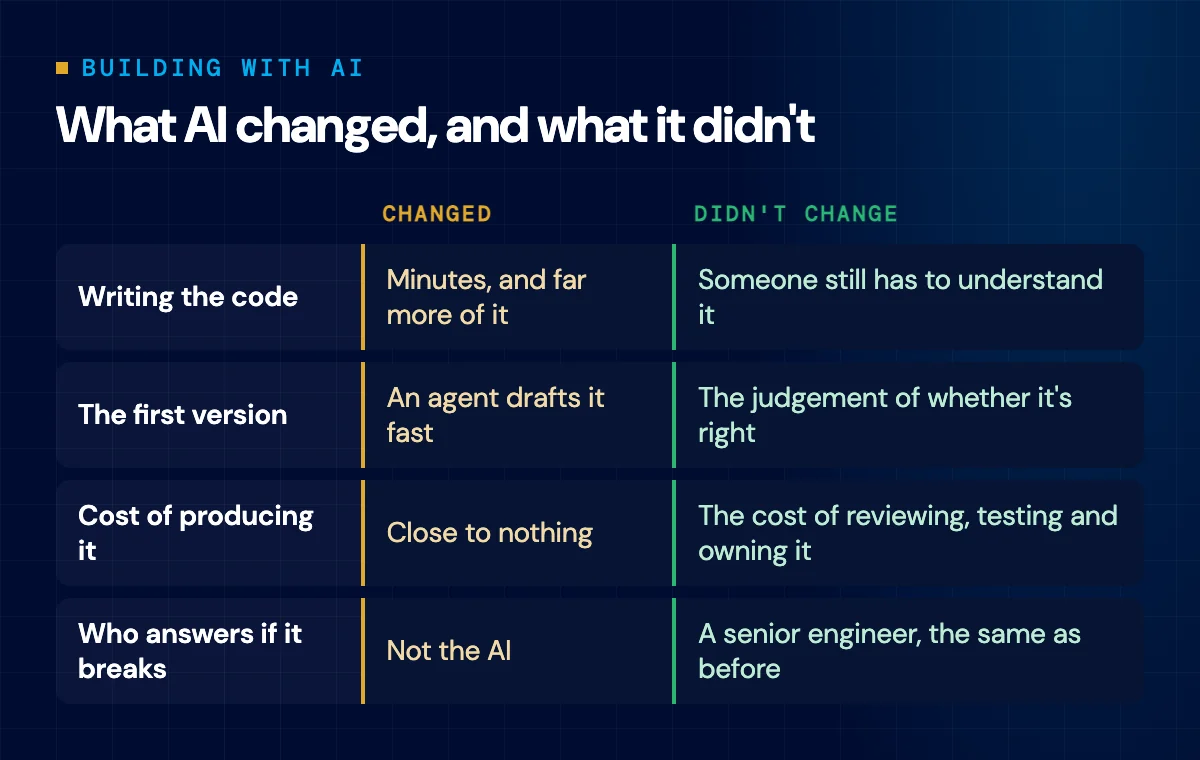
So part of the client's instinct is right. The typing is faster and cheaper than it was. If writing code were the whole job, prices would fall. The reason they don't is that writing code was never the whole job, and AI has made that clearer than ever.
More code, produced faster, demands more discipline
Here's the part that surprises people. The faster you can produce code, the more careful you have to be with it. An agent can write a thousand lines while you make coffee. Reading those thousand lines, understanding them, and being sure they do the right thing takes just as long as it always did.
The No AI Slop manifesto, which we've signed, puts this plainly. It defines slop as what happens "when we put less effort into producing something than we ask the consumer to spend understanding it." Producing is now almost free. Reviewing costs the same as ever. When a team ships whatever the AI produced without owning it, that gap lands on everyone downstream: the next engineer, the user, and the business.
The manifesto's other line we keep coming back to: "AI cannot replace human judgement, it can only amplify our judgement (or lack thereof)." A good engineer with AI is far more productive. A careless one is now far more productive at making a mess. The tool magnifies whatever discipline you bring to it. So the more code AI lets us produce, the more our process, our review and our human oversight decide the result.
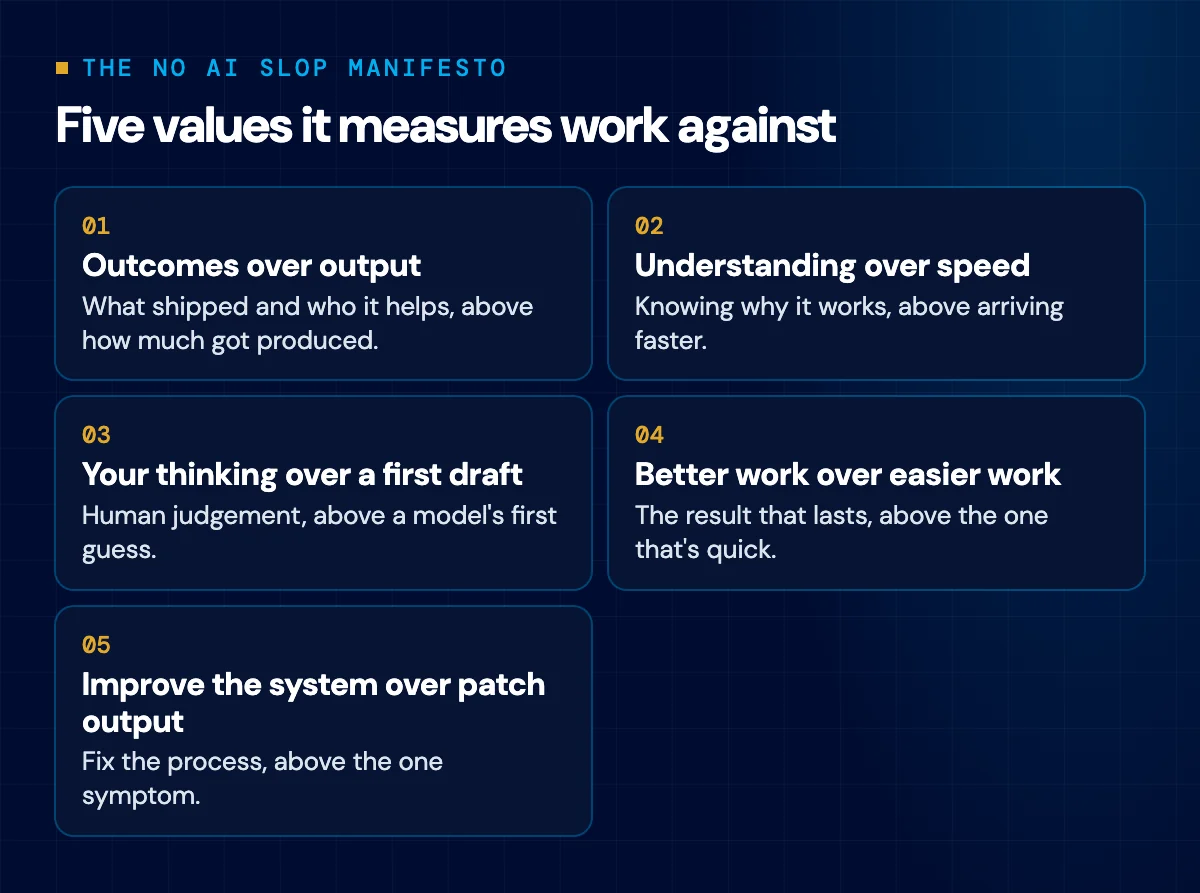
The manifesto puts five values at its centre, and they're a fair description of how we try to work too.

What the early research is finding
This isn't only how it feels to us. The first studies of AI-assisted development point the same way.


In a 2025 randomized trial by METR, experienced developers working on real issues in code they already knew took about 19% longer with AI tools, while believing AI had sped them up by roughly 20%. The distance between how fast AI feels and how fast it is, is exactly where unchecked work slips through. That doesn't mean AI never helps. In the right hands and on the right task it clearly does, which is why we use it. It means the speed isn't a given, and how fast a thing feels is a poor guide to whether it's finished.
Google's DORA research, across tens of thousands of professionals, links AI adoption to higher output and, in the same breath, lower delivery stability. More change, moving faster, with more that can break when no one is watching.
On security, Veracode tested AI-generated code across more than a hundred models and found that around 45% of it introduced a security weakness, a share a late-2026 update put near 38%. The newest and largest models were barely better, and the context-dependent flaws behind cross-site scripting were among the hardest for it to get right. It's the same risk we wrote about in how secure your Odoo is.
Slop compounds, so a clean foundation is worth more now
One point in the manifesto is easy to skip past and matters a lot for a business: slop compounds. An AI assistant builds on what's in front of it, your existing code, your past documents, the earlier messages in a thread. Give it a clean, well-organised system and it extends that. Give it a tangle and it copies the tangle, at speed, because the quickest path is almost always to add more in the same style.
The data points the same way. GitClear studied 211 million changed lines of code through 2024 and found duplicated blocks climbing while refactoring, the slow work of cleaning code up, fell to the lowest level on record. 2024 was the first year where copy-paste outweighed refactoring. AI is quick to add and slow to tidy, so every shortcut becomes something you own and maintain for years.
That makes the foundation you build on worth more than it used to be. Keeping your Odoo and your custom code clean and understandable is no longer just housekeeping. It's what lets AI speed you up instead of multiplying your problems, and it's a large part of what our support and maintenance protects.
What you're actually paying for
When you hire us for a project, the code is the cheap part. Here's where the work really goes.
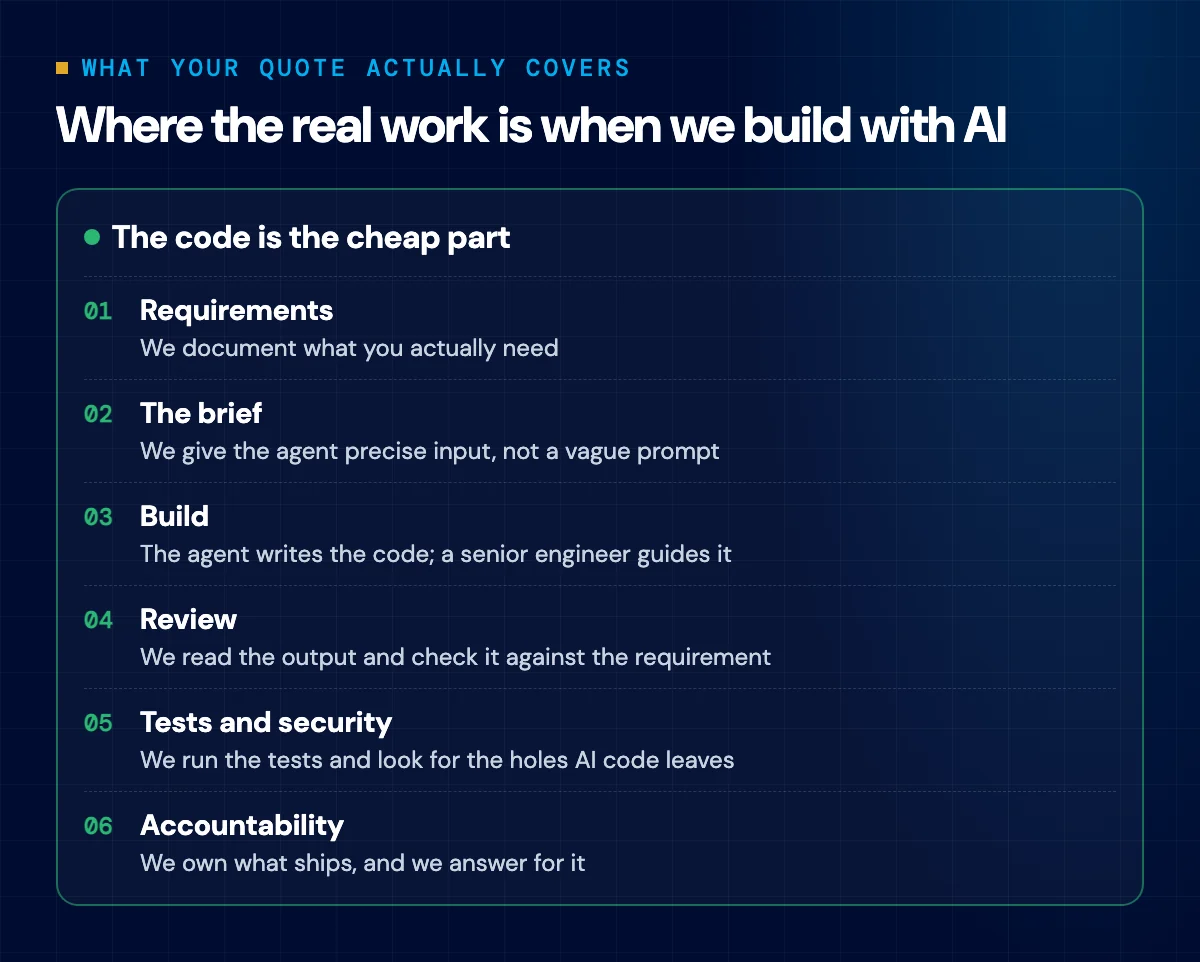
- We work out what you actually need. Many projects fail at the requirement, long before any code. We spend the time to understand your business, write down what the software has to do, and agree it with you.
- We give the agent the right input. A good result starts with a precise brief: the context, the constraints, the edge cases. A vague prompt gives you a vague, confident draft that looks finished and isn't.
- We read and validate what comes back. We check the output against the requirement. AI code almost always runs, so running was never the real test, and that's exactly why it gets shipped without anyone asking whether it's correct, safe or maintainable.
- We run the tests and the security checks. AI often takes the shortcut a careful engineer avoids, and those shortcuts are where bugs and security holes live. Our AI code assessment exists for this, and our article on the security risks of AI-generated code goes through what we look for.
- We stand behind the result. When it ships, it's ours. If it breaks, you call us, and we fix it.

The pressure to call it done
The manifesto is honest about where most slop comes from: pressure. When everyone believes AI has made work nearly free, the expectation becomes more, faster, cheaper, and the first thing dropped is the review. That pressure is the force behind the very question we started with. It's a reasonable thing to ask, and it's also what produces slop across the industry right now.
Part of what you hire us for is to hold the line under that pressure. We move fast where speed is safe, and we take the time to check the things that would hurt you if they were wrong. We're the ones who find out whether it's right before it reaches you.
Accountability is the product
Think about the moment something goes wrong, when a payment fails late on a Friday or a report shows your board the wrong numbers. In that moment, the AI that wrote the code isn't on the call, and it can't be held to anything. It doesn't carry your risk or lose sleep over your business.
A person does. At NavyBits, a senior engineer leads every project, and we sign an NDA before we touch your code or your idea. When we hand you something, we're saying we understand it, we've checked it, and we'll answer for it. That promise is the same whether a human or an agent typed the first draft. It's what you can't get from a tool, and it's most of what you're paying for.
This is why we price work the way we do. Two teams can both "use AI" and deliver very different things. One sends you the agent's first draft and moves on. The other documents the requirement, briefs the agent well, reviews every output, tests it, checks it for security, and puts its name on the result. The code might even look similar. The responsibility behind it is not.
What this means for your project
Using AI well is a discipline, and it's one we've built our work around. You get the speed, which shows up as more done in less calendar time and a fair price for the scope. You also get the part that protects you: a clear requirement, a senior engineer who owns the outcome, and a team that's accountable long after the code is written.
And when the same kind of mistake shows up twice, we strengthen the process that let it through, with a test, a check or a review step that catches it next time. The manifesto calls this improving the system rather than patching the output, and it's how a team keeps quality steady while it moves quickly.
So when you ask why it still costs what it costs, that's the honest answer. The price is for making sure what you build is right, safe and yours, and for standing behind it long after the code is written.
Work with NavyBits
NavyBits has been an official Odoo partner since 2017, with 10 Odoo-certified experts, and a senior engineer leads every project. We build with AI and we're accountable for what it produces, on Odoo and on custom software. If you've already built something with AI and want a second set of eyes, our AI code assessment reviews it for security, maintainability and readiness.
Book a free 30-minute call with a business consultant and an engineer. Tell us what you're building, and we'll tell you how we'd approach it and what it takes to do it right.
FAQ
If you use AI, why isn't the work cheaper?
Parts of it are, and that shows up in how much we can deliver in the time. But writing code was never the whole job. The requirements, the review, the testing, the security checks and the accountability take real work and real experience, and AI doesn't remove them. It makes them more important, because there's more code to stand behind.
Does NavyBits use AI to build software?
Yes, on client work, with engineers guiding and reviewing every change. AI lets us build faster. What we sell is the discipline and accountability around it, so you get the speed without the risk of shipping something nobody checked.
Is code written by AI safe to use?
Not on its own. Independent testing by Veracode found that around 45% of AI-generated code introduced a security weakness, and the newest models were barely better. AI code usually runs, which is why it gets shipped without review, and it often takes shortcuts that leave bugs and security holes. It's safe when a person reviews it, tests it and checks it for security before it goes live. That review is the job.
Who is responsible if AI-written code fails?
We are, for the work we deliver. A tool can't carry responsibility. A senior engineer leads every project, we check what we ship, and we answer for it if something goes wrong.
What is the No AI Slop manifesto?
It's a statement by engineers that the quality of AI-assisted work is a human responsibility, and that using AI doesn't excuse passing on work you haven't checked. We signed it because it matches how we already work. You can read it at slopmanifesto.com.
Will AI replace developers and consultants?
It's taking over a lot of the typing. The judgement about what to build, the review of whether it's right, and the person who's accountable for the result are still human, and they're becoming more valuable as the code itself gets cheaper.